


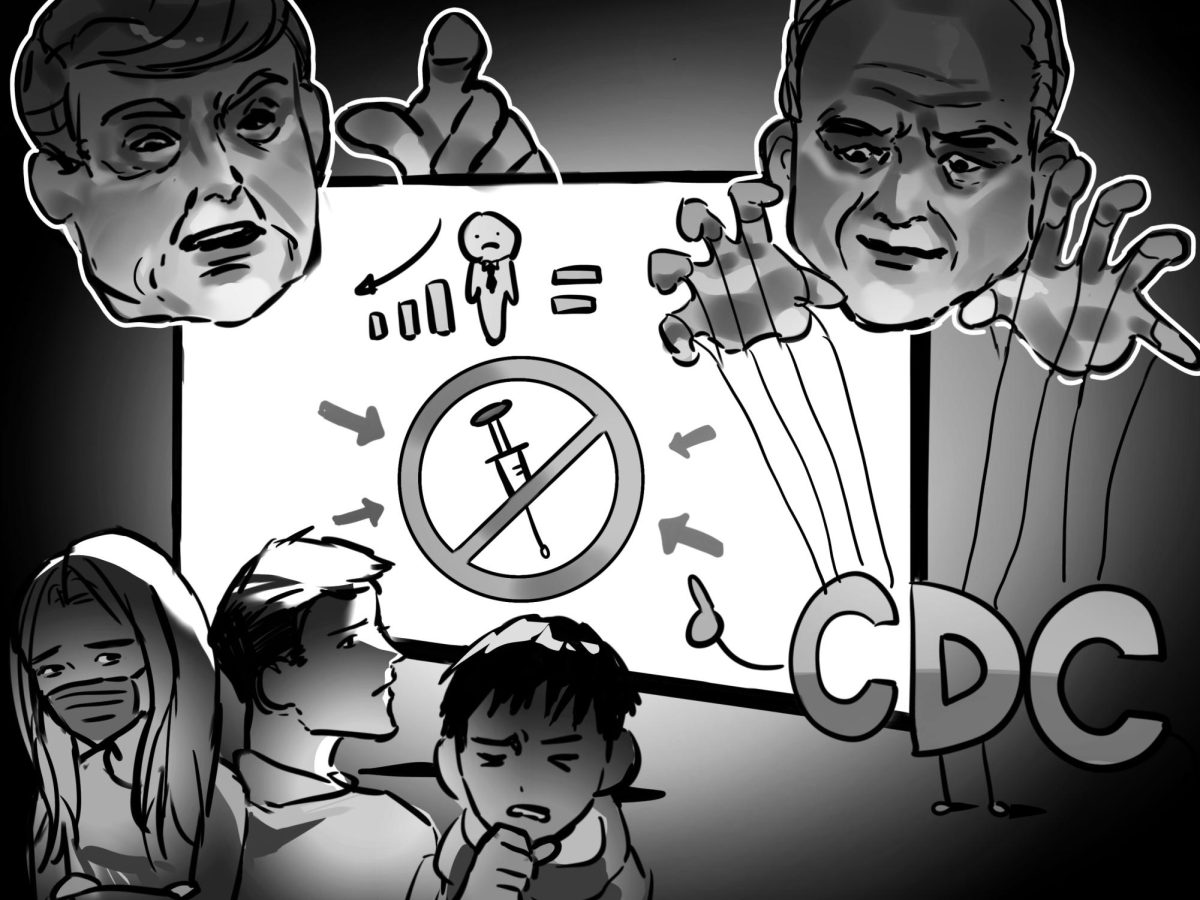









































On Jan. 5, the US Department of Health and Human Services (HHS) changed the recommended childhood immunization schedule, reducing the recommended vaccines from 17 to 11 throughout adolescence. Vaccines such as those for COVID-19, influenza, and rotavirus are administered by a physician’s recommendation rather than provided by federal legislation. Trump’s anti-science agenda protects partisan and economic interest by undermining expertise that challenges his administration’s narrative and depreciates public trust in health.
According to a study done by the National Institutes of Health (NIH), vaccine skepticism was correlated with far-right political parties and exacerbated by political polarization. This aligns with the current U.S. government, consisting of a majority right-wing cabinet—most notably, HHS Secretary Robert F. Kennedy Jr.
Kennedy has continuously spoken out against vaccines as the corrupt production of “big pharma” and has canceled multiple studies on vaccine creation. Kennedy also appointed board members known for their hyper-partisanship to the Center for Disease Control’s (CDC) Advisory Committee on Immunization Practices (ACIP). These professionals had no formal experience as public health researchers, showing how Kennedy disregards qualification in favor of compliance. Furthermore, the secretary himself is a lawyer with no medical or research experience.
Science and medicine should remain unbiased and objective; politics should not interfere with health, which directly impacts millions of lives nationwide. The implications of the schedule change mean that fewer people will get essential vaccines, as the ACIP will only fund the vaccines on the official childhood immunization schedule.
Additionally, funding for the NIH was cut 15%—around 4 billion dollars—meaning the research that had previously led to groundbreaking prevention methods could not be sustained at its current level. This is a move by the administration not only to relocate research funding elsewhere—perhaps to finance ICE activity or other political endeavors—but also to force a one-sided negotiation between the red states and the NIH.
The administration attributed the cuts to research funding as overinvesting in blue states, such as Massachusetts, Connecticut, and Maryland. Rather than celebrating the pioneering achievements of the country as a whole, the administration chooses to hinder scientists’ progress simply because the values they uphold go against Trump’s power.
While the HHS released this reduced schedule, it was created by individuals who are heavily anti-vaccination and unfit to work in the health field, so citizens must consider the implicit biases that are involved in the official recommendations. Whether it is a lack of professional training, the pursuit of economic or political power, or internal beliefs, opinion should not intrude on citizens’ health and bodies.
When the vaccinations of highly contagious diseases are only recommended, people are less incentivized to take them and more likely to act on misinformation. Support from medical professionals like the American Academy of Pediatrics is directed towards the previous schedule, yet the government continues to disregard their research.
Although the changes were aimed to address the lack of public trust and align the U.S. with other countries, these reasons go against professional opinions. The lack of public trust in vaccines could be improved by publishing, funding, and publicizing more research-backed articles, a stark contrast to the actions of the current administration. The 17-vaccine schedule in the U.S. is similar to South Korea and Brazil’s models, so claiming the U.S. is a “medical outlier” is a fallacious argument that disguises the cuts to vaccinations as “alignment” rather than the hindrance of science.
The anti-vaccination rhetoric is harmful and arguably life threatening due to its potential implications on children, elderly, and immunocompromised people. Citizens, as part of a just society and fair country, have a moral obligation to uphold herd immunity for those in need. Politicizing science reduces the idea of an objective experiment to pushing a certain agenda, impacting millions of decisions and even more lives. The government should be held accountable not only for providing truthful, objective research, but also for working towards the good of the citizens rather than prioritizing its own agenda.